

DFB (Distributed Feedback) LD
- Single Transverse Mode
- Single-frequency Mode
- Mode-hop-free Operation
Concept Product
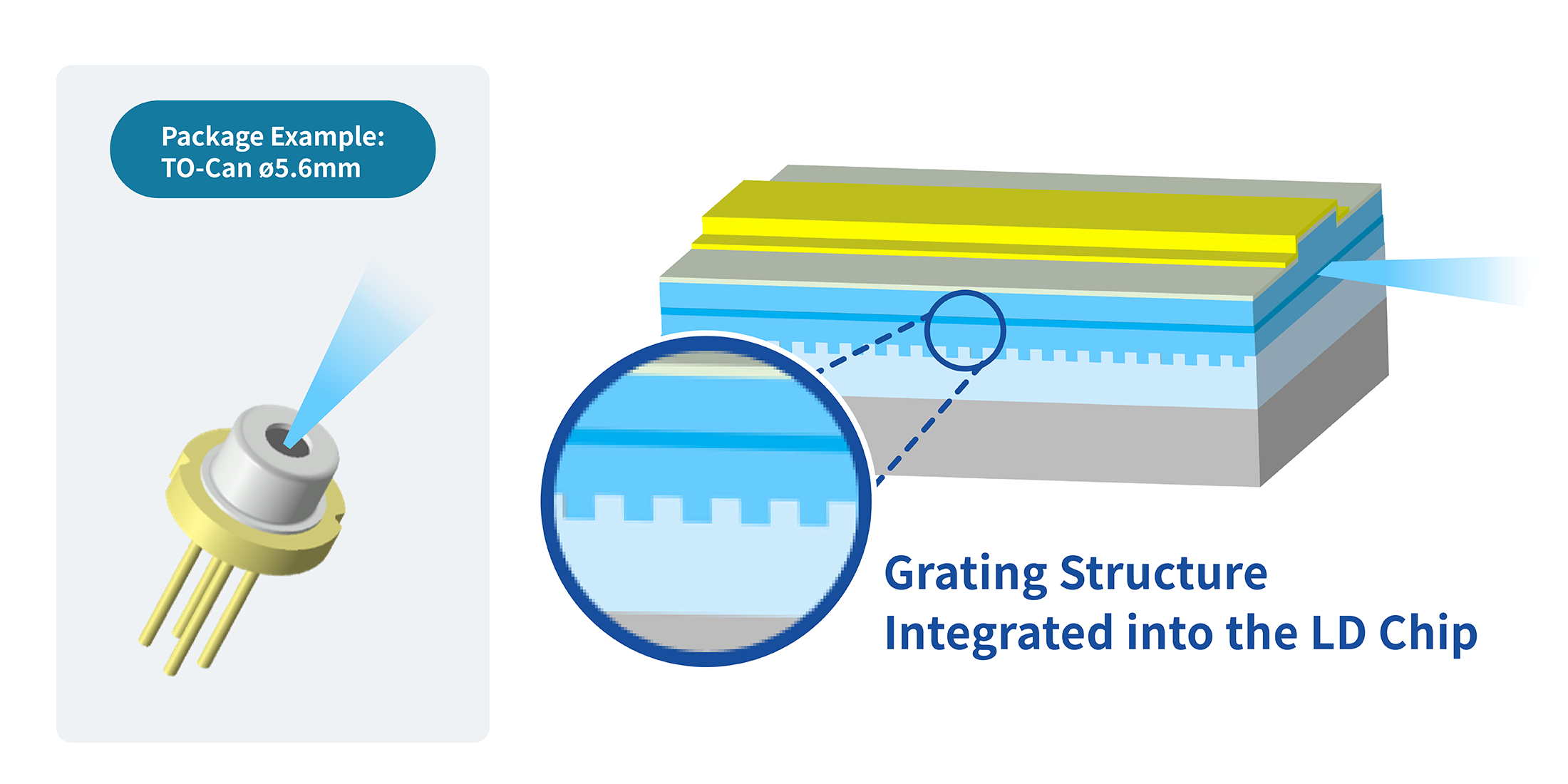
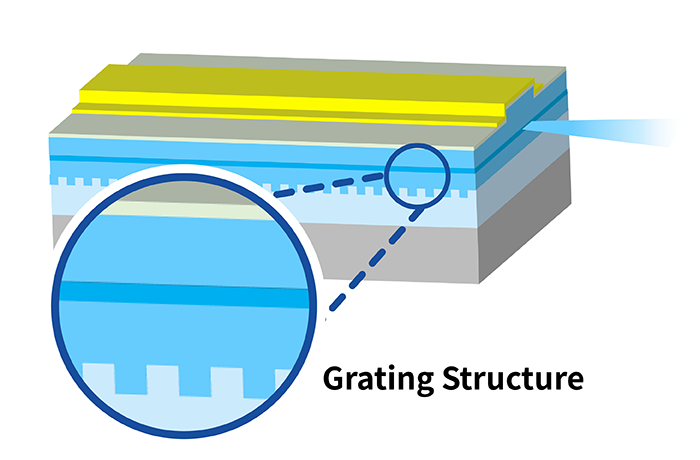
Transverse single-mode semiconductor laser in which a grating pattern is built near the active layer inside the laser chip along the waveguide direction. It enables single-frequency laser oscillation. It is useful for applications requiring narrow spectral linewidths, such as interferometric metrology and Raman spectroscopy. Various wavelengths can also be achieved by customizing the grating period and the gain bandwidth of the active layer.
Specification Example1
Specification
| Items | Symbol | Spec (Typ.)* | Unit |
|---|---|---|---|
| Peak Wavelength | λd | 460-470 | nm |
| Optical Output Power | Po | 20~50 | mW |
| Forward Current | IF | 200 | mA |
| Forward Voltage | VF | 5.0 | V |
| Beam Divergence** | Parallel (θ∥) | 9.0 | ° |
| Perpendicular (θ⊥) | 22.3 | ° | |
| Transverse Mode | - | TEM00 | - |
| Spectral Linewidth | Δf | <20 | MHz |
*Po=50mW, Tc=25°C, CW
**Full angle at 50% from peak intensity
Emission Spectrum
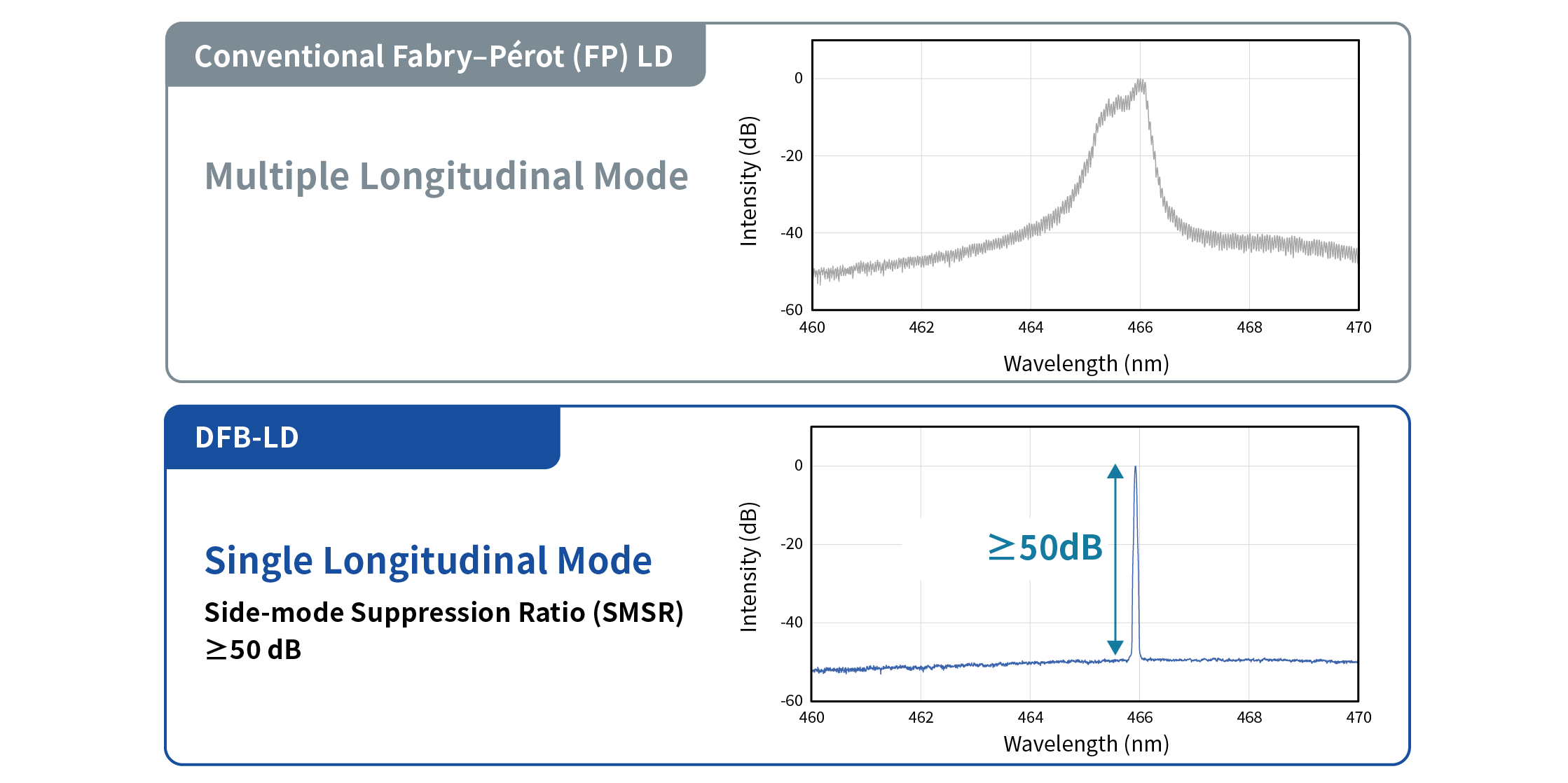
The graph shows a comparison of the emission spectra of a distributed feedback (DFB) semiconductor laser and a conventional Fabry–Pérot (FP) semiconductor laser. While a conventional FP semiconductor laser exhibits multiple longitudinal modes, a DFB semiconductor laser operates in a single longitudinal mode. It also achieves a side-mode suppression ratio (SMSR) of 50 dB or higher.
Temperature Dependence of Peak Emission Wavelength
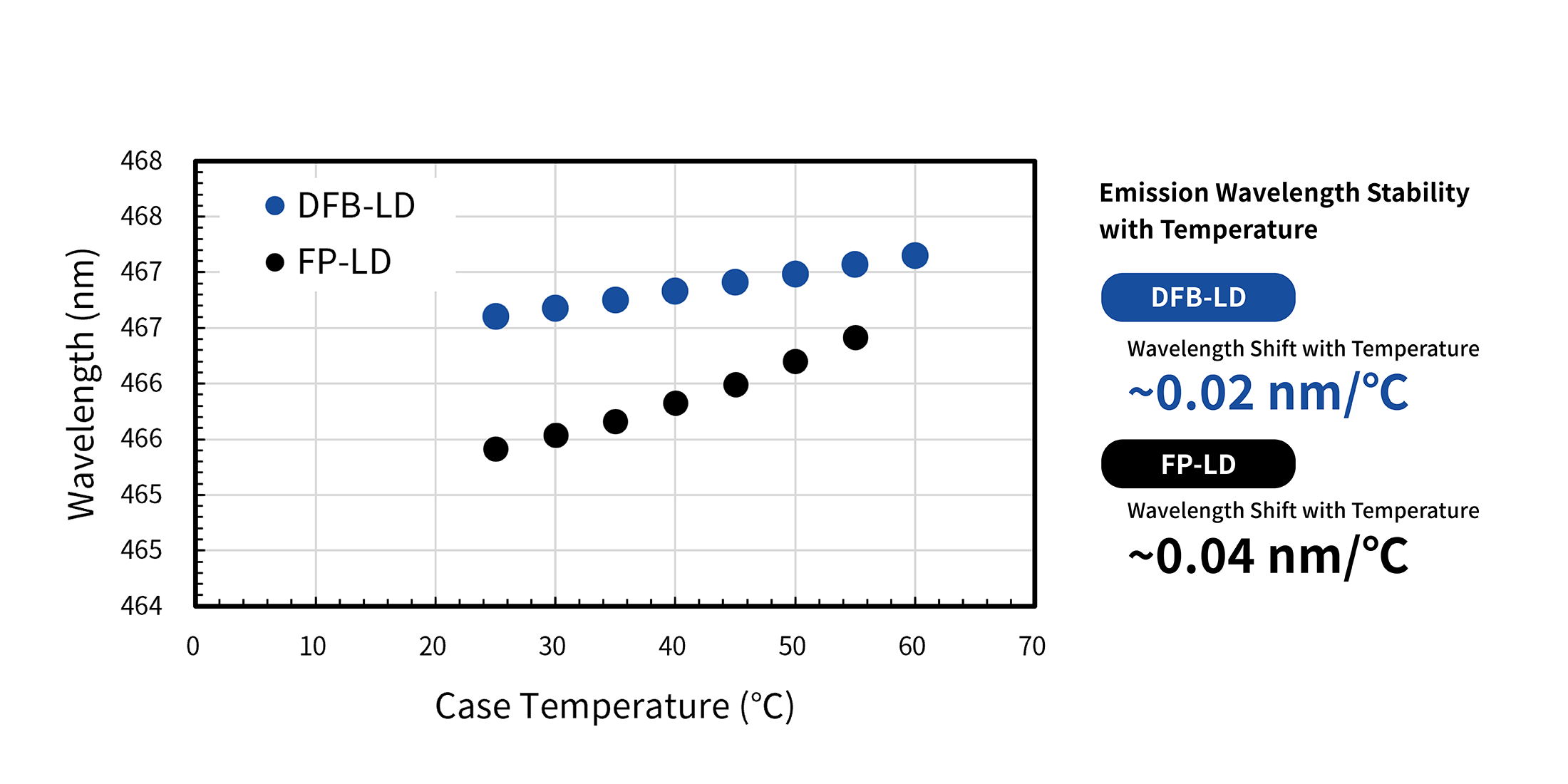
The graph shows a comparison of the temperature dependence of the peak emission wavelength of a DFB semiconductor laser and a conventional FP semiconductor laser. Compared with the FP semiconductor laser, the DFB semiconductor laser exhibits a smaller change in peak emission wavelength with temperature.
1These are tentative values as the product is still under development.
Example Applications
- Interferometric Measurement
- Raman Spectroscopy
- Other Measurement and Spectroscopy Applications
- Atomic and Ion Excitation
Contact
Nichia has the ability to support a wide range of wavelengths through chip customization.
For more information or product inquiries, contact Nichia.